

"Paper Jane"
Janine Barchas looks back at 250 years of Jane Austen


On December 16, 1775, future novelist Jane Austen was born in a village in Hampshire, England. Two hundred and fifty years later, her birthday celebration has spanned continents and lasted for months, complete with newspaper features, commemorative teas, and a birthday parade in Bath.
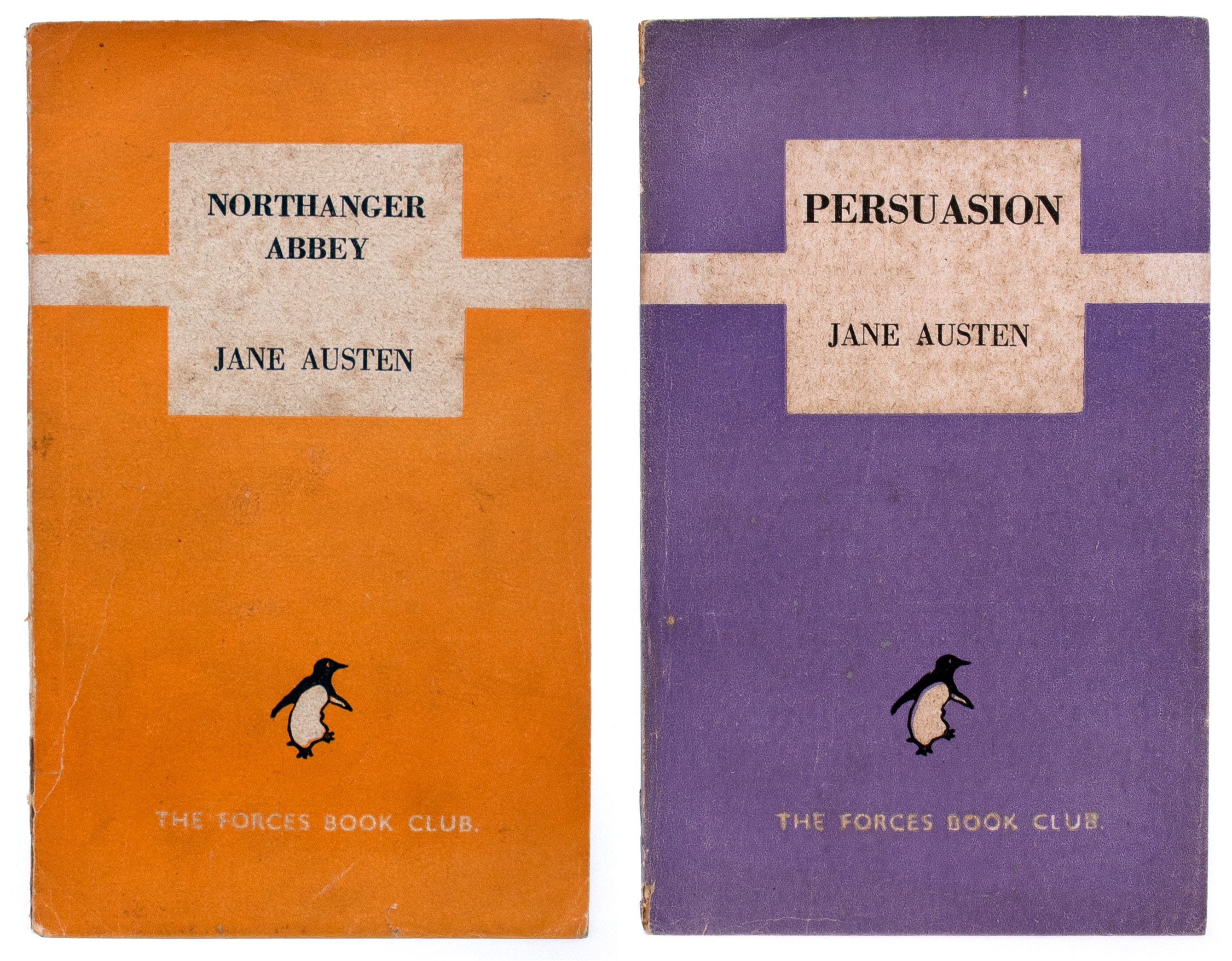
Of course, it’s not just Jane herself that’s being celebrated — there are, after all, her novels to consider. From elegantly bound volumes to mass market paperbacks, the many iterations of Austen’s books have profoundly shaped her fame and public reception, and no anniversary would be complete without a close look at this material legacy. So argues Janine Barchas, professor of English at UT Austin and author of, among other titles, The Lost Books of Jane Austen. And so argues “Paper Jane: 250 Years of Austen,” an exhibition at the Grolier Club in New York City on which Barchas served as co-curator. With exhibits ranging from first editions to “pinked” paperbacks and signed film posters, “Paper Jane” tells the story of Austen’s growing fame through her print history and examines the way her extended family and their descendants used their own publications to both reveal and obscure her life and work.
Earlier this month, I spoke with Barchas about the exhibition and Austen’s enduring popularity. Our conversation below, which has been lightly edited and condensed, covers the Grolier Club, “public intimacy,” and the many generational adaptations of Pride and Prejudice. Read on for more, and if you’re in the New York area, you can race to catch “Paper Jane” in person through February 14. For the rest of us, there’s always the web version.
Janine, thank you for making time to talk to me about “Paper Jane”! To get us started, give me the in-a-nutshell intro to the exhibition: what it is and why it’s at the Grolier Club.
The Grolier Club is America’s oldest book collecting club, and its exhibitions, like this one, are open and free to the public. The “Paper Jane: 250 Years of Austen” exhibition is really a love letter to Jane Austen that showcases the books and objects — very unequal and eclectic — owned by three collectors, of whom I am one. All of us are members of the Grolier Club with different expertise in Jane Austen and different collecting strategies and goals.
Austen is an author who wrote only six published novels, so you might think, well, what is there to collect other than those six books? But it turns out that one of us focused on collecting the scholarly history, especially books by members of the extended Austen family, and tracking their interferences and contributions to Jane Austen’s reception history. One of us is a schoolteacher who collected very widely, starting with first editions, but who also is interested in how children read and interact with Jane Austen. Did Victorian kids in Britain have a different idea of Jane Austen than, for example, American kids in the 1940s or 1960s?
And then there’s me, who wrote a book called The Lost Books of Jane Austen. For that project I collected for years the cheapest, most throwaway, tawdry, least-authoritative editions of Jane Austen that had enjoyed, in my view, the largest readership and therefore exerted the greatest impact on her reception history. These are editions with misprints galore that don’t get collected by rare books libraries because they’re not important firsts, but they are the reprints that kept her name alive and fed her reputation. Those were the copies that had the widest readership, whereas Jane Austen’s first editions had a very narrow, elite readership. She was a bit of a sleeper during her own lifetime and did not enjoy the kind of popularity that we associate with her now; that popularity grew over time.
The three of us put together “Paper Jane” for the 250th anniversary. It has five different sections that cover 50 years each, organized temporally. That allows you to see, during each 50-year increment, what happens to Austen’s reputation. What does she look like in terms of her material incarnations as books? And each period in the show offers a different perspective — a different Jane.
Walk me through how this came about. At what point did you and your co-curators think, “we could really pool our resources, both intellectual and material, and put on this show for this major anniversary?”
Because the Grolier is a book collecting club, you already have that context of people meeting because they share certain kinds of interests. And Sandra Clark and I had already worked together on The Lost Books of Jane Austen, for which she opened her collection to me as a scholar. It’s a mode of working that is just magical, really: to be able to rifle through someone’s collection in their home, to be able to befriend them and talk over things and use their private archive. I’d had that experience working with Sandra and knew her collection complemented mine in many ways. Hers was so much more extensive than mine that it cemented the claims that I would otherwise not have been able to make. She had collected for 50 years and I had only been doing that for a decade or so at the time of our joining forces, so she had so many more of these lost books than I had been able to find amongst the flotsam and jetsam of eBay.
So Sandra and I had already worked together. And when, as part of the Grolier Club, we met Mary Crawford, whose name is identical to that of a character in Mansfield Park…
I loved that that’s called out on the website and in the notes for this exhibition. “Mary Crawford — not the character.”
So we knew one another and our shared interests. And as you do when an author you love is having a standout anniversary, you put your heads together and say, “Hey, how can we share our interest with others and bring people to the Grolier?” Once we had conjured up the idea of dividing the exhibition into 50-year increments, it became clear how we could pull from each of our collections to tell a larger story about her changing reputation.
Now we keep saying that the result is more than the sum of its parts. None of us could have done anything like this on our own. It’s only when you put different collecting instincts together — and of course a scholarly library or a scholarly context ultimately does that, pulling from different individuals and their perspectives — that you can shape a new story.
When you’re putting together an exhibition, many people have to collaborate to make it happen. Whereas, when we lay folks think about the typical work of an academic — writing a book, for example — the idea we often have is one of solitary pursuit. How do you think about or approach the differences between those two kinds of projects?
Everything has its place and its importance. I learn different things from writing a book, and the depth of the research behind something like that is different than what you do for an exhibition. In a way the exhibition comes last. It comes after all that learning and is an opportunity to showcase the learning in a different way and reach a different audience. Just as teaching and scholarship go hand in hand, an exhibition is a different product of the same intellectual work that it takes to write a book. You’re using the same material, but it has to be presented differently. You can’t just take a paragraph from a book and turn it into a museum label.
And while I enjoy my own solitary time in my intellectual cave here and there, I really do also enjoy what it means to coordinate with other people, and not just about taking your ideas and putting them in front of a new audience in an exhibition. Rather the collaboration means that the end-product is something you couldn’t have generated on your own. There’s growth and learning that happens in the process itself.
What did you learn from putting this exhibition together?
Everyone has their prejudices, and coming into this exhibition I had my prejudice against the Austen extended family during the Victorian period. All those interferences! I just wasn’t really interested in all those Victorian relatives who sanitized and adjusted their Aunt Jane’s reputation. But the other collector, Mary Crawford, pointed out in our discussions that yes, but these books were still very important. Even though members of the Austen clan did sanitize and edit out things and commit these horrible crimes that I was accusing them of, they nonetheless also showed people Jane Austen’s voice in letters that the world had not yet seen. That newly published material then generated new thinking and new scholarship about Jane.
After a while there were so many things she mentioned that, quite frankly, I’d never read, that I began to read them. And I began to ask questions like, how’s this book related to this other book? Whose relative was that? Mary ended up drawing us a sort of schematic to explain it all, and once we started working on that visual explanation, it was clear that this “family book tree” had to be part of the show.
Even though I still feel that not all these family contributions were by any means equal, and not all of them were for the better, the sheer number of them kind of convinced me that yeah, of course they had this extraordinary impact. You can dismiss them as misguided, but that isn’t the whole truth. So, occasionally this sort of scholarly habit of sneering at this or that popular thing gets corrected when you work with other people who rightly see the value of those things. There’s some course correction that happens that’s really healthy.
Now, the second part of the question: What do you hope that a visitor would take away from visiting “Paper Jane”?
I would hope that a visitor who knows nothing about Jane Austen enjoys walking through a timeline of what is essentially book history and pop culture to see what the last 250 years in print looks like for an author that they may not have ever read. Although I think you’d be hard-pressed to find somebody now who hasn’t been exposed to Jane Austen in some way.
At the same time, we’ve been very gratified by reactions from other Jane Austen scholars and fans who know a great deal about her but who nonetheless have never seen a first edition of this novel or a railroad edition of that one and who can now see the popular culture kaleidoscope that Jane Austen was in the early period.
I have a confession about this exhibition, which I think gets at something about how we think about Jane Austen generally. When you first told me about this project, you said, “here’s some information about my ‘Paper Jane’ exhibition,” and I thought for a long time that the title of the exhibition was “My Paper Jane.” Now, looking back on that misunderstanding, there’s something about that possessive “my” that feels appropriate. A lot of people really feel a connection and almost an ownership over the works of Jane Austen in a way that feels unique.
Yeah, I think they do. Janeites call themselves “Janeites,” and I don’t think that Shakespeare fans call themselves “the Willies,” for example.
I wish that they would! But we don’t really do this with other writers to the same degree, and I wonder if you have any insight into why that is.
There is an intimacy that readers feel with the works of Jane Austen, and it might have something to do with how novels are read silently and alone. At the same time, movies do bring people together, and now Jane Austen’s popular on the stage too. But there is an intimacy to reading.
Joe Roach, who is a scholar of celebrity culture at Yale, calls any feeling of intimacy with a celebrity “public intimacy.” Celebrities awaken that feeling in a fan — true fandom — which is about feeling that intimacy with, in this case, a writer, or with actors from the screen or the stage. And that public intimacy is something that defines Jane Austen’s celebrity for certain. I don’t know if it’s more so than other writers, but it might be a reflection of her celebrity, of how famous she is, that people feel that close connection to her. It might be an aspect of fame rather than an aspect of her writing specifically.
Oh, that’s interesting. I would’ve thought the opposite, that she’s famous because she inspires this connection. But it could be the reverse, that her fame is what draws people closer to her.
It could also be a chicken and the egg issue.
Absolutely. And whatever the cause, I imagine that dynamic is something that you have to navigate as a scholar and teacher of Jane Austen.
I have taught many older novels that I need to sell to my students, where they’ve never heard of the authors and I really have to sell them on the book before they are willing to crack the spine. Like, “You really want to read these because they’re great! Let me tell you how great they are so that you will want to invest your time.”
And those are novels by Frances Burney, Sarah Fielding, Henry Fielding, Aphra Behn, Eliza Haywood, Samuel Richardson. These are people who do not have an action figure and don’t have a movie and have no celebrity status anymore, even though they were bestselling authors in their day. So, I know what it’s like to have to sell a book and promote it and maybe even inflate its importance in order to make people pay attention.
When it comes to teaching Austen, it’s the opposite. You’re speaking to a room that’s already convinced. They already love her, and now it’s about turning that love into something productive so that we’re not just talking about how great Mr. Darcy is or how much Mrs. Bennett looks like our mother. I tell my students those things are off the table. I don’t want to know your feelings. Your feelings are for sharing with your friends. Let’s look at these passages; that’s what we’re doing here. But it’s a lot easier when you have to say “keep your feelings to yourself and let’s look at the book,” because those feelings animate interest, and they already direct a students’ gaze to the page. Whereas, when it comes to the lesser-known novelists who made Austen possible, it’s heavy lifting, no matter how great they were in their day. And that’s partly because, you know, Hollywood is working for me when it comes to teaching Jane Austen.
Absolutely. There’s always another adaptation just around the corner.
And I can’t wait for Netflix’s new Pride and Prejudice that they’ve promised to release this year.
I hadn’t heard about this. That’s exciting. And Pride and Prejudice in particular feels so generational, doesn’t it? I was of the Keira Knightley generation…
Of course you were! As she rolls her eyes.
Whereas my mother-in-law, who is a devoted Jane Austen fan and has been her whole life, can’t stand the Keira Knightly adaptation.
I’m with your mother-in-law on this one. But ultimately I love them both for bringing students into my classroom.