

Why the Wild Things Are
UT psychologist Jacqueline Woolley explores the value of magical thinking


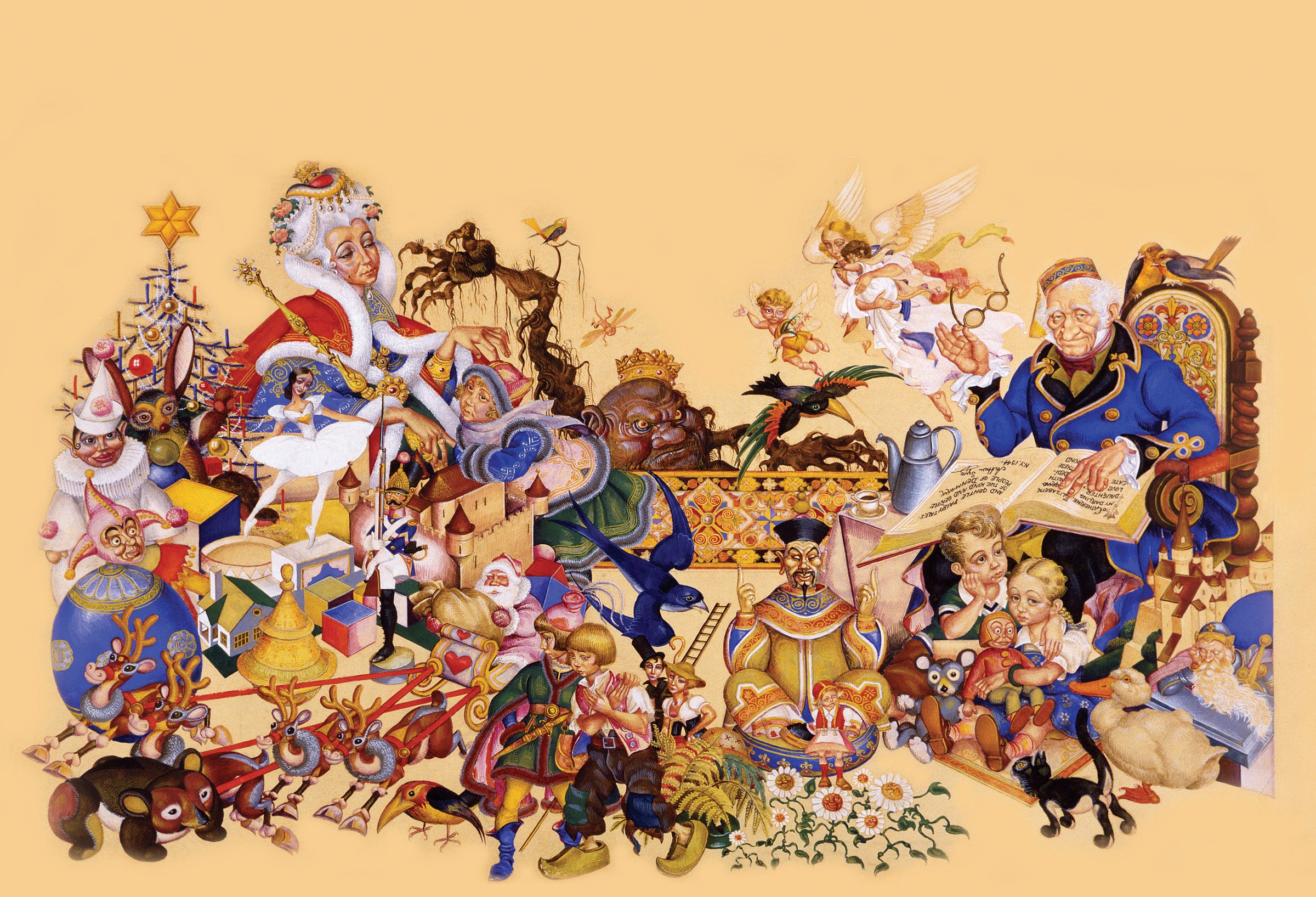
._Andersen%27s_Fairy_Tales,_inside_cover_illustration_(1944),_New_York.jpg)
Did you have an imaginary friend as a child? A stuffed animal you told your deepest secrets to? A longstanding hope you’d catch the Tooth Fairy in the act?
If the answer is yes, you’re in good company. Not only do almost all children engage in imaginative play involving made-up characters, pretending, and belief in the existence of things that aren’t real, but that imaginative play is crucial to learning to identify what is real. And our understanding of the distinction says a lot about who we are, as humans, when we grow up.
Jacqueline Woolley, a psychologist at The University of Texas at Austin who regularly teaches a course called “Why We Believe Weird Things” and whose research and teaching focuses on these phenomena in children, says that imaginative thinking of this type starts much earlier than you might expect. Her own research into the fantasy/reality distinction concentrates on kids as young as 3, when they’re able to speak somewhat expressively, but other research indicates that even infants seem to have the ability to differentiate between real and not-real things. It’s this distinction that enables kids to create vivid imaginary companions but not confuse them with their real friends, Woolley says. It’s also what enables kids to distinguish between what’s possible — like walking — and what’s not — like walking through a wall.
Woolley stops short of saying that this type of thinking is innate. As a psychologist, the question of nature versus nurture underpins most research in her field, and she notes that we are introduced to environmental, or “nurture,” factors basically from birth. But she does believe that humans are born with certain predispositions that facilitate beliefs in fantastical things.
Take the human tendency to identify patterns. “We’re always looking for things that kind of fit together or that maybe look like something else,” Woolley says, and this type of “connection finding” sometimes causes us to recognize patterns and affiliations that don’t exist. We may also experience two events that happen close in time and then mistakenly infer that they’re causally related.
“This is how a lot of superstitious beliefs form,” Woolley says. “We might wear blue one day, win our tennis tournament, and think those two things are connected by the same basic physical causality as when a ball rolls and hits another ball and makes it move. These two things happened close in time, so we infer that there’s some special relationship between them.”
As a species, we don’t like to feel out of control, Woolley explains, and our superstitious beliefs help us feel in control of our lives. If you want to win your tennis tournament, you may make sure to wear blue. If you want control over something bigger, like why bad things happen, you might look to fate, the supernatural, or even God.
The connection between the imagination and superstitious or supernatural belief might also explain why there are some cultures in the U.S. that discourage this kind of imaginative thinking, Woolley says. For example, certain fundamentalist Christian groups don’t suggest to children that there may be some other omniscient being other than God (like Santa, for one). And the Mennonites, who seem to steer their kids away from pretend play and fantasy worlds, might do so because they want their children to focus that productive, generative energy toward their community instead. Interestingly, research shows that kids in these cultures still believe in Santa and still engage in pretending, even if they keep their beliefs to themselves.
But how exactly does one measure an understanding of “reality” anyway? Asking small children these kinds of philosophical questions can be challenging, Woolley says, but it’s also essential to her research. One way she helps define reality to kids is by defining what it’s not. “Is this real or is it a dream?” she asks. “Is it real or is it fake? Could this happen in the real world, or could it not happen?”
“I feel like it’s hard to ask about reality without presenting which alternative you’re talking about,” Woolley explains, “so we try to capitalize on that with kids.” And, she’s found, the distinction between real and the “pretend,” is one of the first contrasts that kids use in their natural language, often as early as age 2.
So, what does it all mean? And why is it important? Turns out it’s pretty ontological. “It’s a fundamental aspect of adult cognition,” says Woolley. “It’s the basic question of what is, what exists,” meaning this type of imaginative thinking is how we begin to question who we are and why we’re here.
The shared distinction between real and unreal is also necessary for further communication: Without it, we might not be able to talk to kids on their level at all. This ability to communicate with kids in turn enhances their learning by enabling them to engage in a process of “figuring out” what’s real and what’s not. They become active investigators. Woolley says she likes to think of kids’ experience believing in fantastical beings like Santa as “imagining the impossible.” She believes it helps our brains to think out-of-the-box, to be more creative and more innovative, and that this might translate to creativity and critical thinking skills in adults.
But if all this imagination is important for children’s development and likely contributes to creativity and invention in adulthood, what’s the flip side? Is there a danger of having too much imagination? Is there a correlation between creative thinking and adult fringe groups like conspiracy theorists? Can “weird things” somehow go wrong as we age?
“That’s the $64,000 question,” Woolley says. For the most part, these early tendencies seem to evolve into positive qualities. She cites previous research on famous authors that found they were more likely to have had imaginary friends in childhood — but it’s not impossible that the same tendency that allows us to believe in Santa Claus might also allow us to glom on to anecdotal evidence as scientific evidence on the efficacy of a juice cleanse, for example.
“I do see kids who are on the skeptical end of things and kids who are on credulous end of things,” Woolley says. “Is it something that they’re born with? Or is it something about their family environment that is making them this way? That’s the core question of any developmental research. I always think that it’s both.”
Woolley points to adult research on personality, particularly the “Big Five” personality test, to consider why some people are more likely to believe weird things and others not. Openness, one of the components the Big Five measures, aims to measure imagination and curiosity. It’s hard to capture this well in kids, Woolley says, but it may be that some kids are just more open and curious by this definition. Perhaps those are the kids who will turn out to be our inventors or artists, or perhaps those are the kids who will turn out to believe in conspiracy theories.
Another factor that might explain why people believe weird things is cognitive reflection, which refers to how much someone explicitly reflects on their thoughts. “If I give a quiz,” Woolley says, “some people will just spit out the answer right away and other people will reflect for a longer time. This is speculation, but maybe people who are more inclined to reflect about their own thinking are able to resist superstitious behavior or maybe even conspiracy theories.”
But for people who can’t resist conspiracy theories — groups like the Flat Earth Society, for example, who commit their lives to believing something fundamentally untrue — Woolley has found, most of the time, that misguided beliefs rarely come from simple errors in thinking or critical reasoning. In fact, she says, they often come from a much more complex desire that individuals have to belong to a group and to feel like they have some kind of defined identity. That desire is so strong in humans that it can affect belief.
Between the desire to belong, the desire for the control, the desire for patterns, and more, Woolley’s research demonstrates that belief is never as simple as fantasy versus reality. Regardless of our age, imagination and curiosity overlap with and shape our shared sense of reality. So, the next time you wear your blue shirt to your tennis tournament or slip a quarter under your kid’s pillow, remember that the distinction between real and unreal can be as hard to pin down as Santa or the Tooth Fairy.